
What are Commercial Motor Vehicles & How Do You Choose the Right One for Your Business?
Commercial motor vehicles are vehicles registered and used primarily to transport goods or fare-paying passengers for a business. Under the Land Transport Authority (LTA), the category is not defined by a vehicle’s size or physical appearance. LTA defines it by registration type and maximum laden weight (MLW), and those two factors determine plate designation, parking rules, and compliance requirements.
The difference between a commercial and a non-commercial vehicle traces back to registration. Private vehicles are registered for personal use and fall under a separate LTA category. A commercial vehicle’s obligations begin at registration and continue through every operational requirement that follows.
LTA also recognizes four classes of goods vehicles by MLW: Light Goods Vehicles (LGVs), Heavy Goods Vehicles (HGVs), Very Heavy Goods Vehicles (VHGVs), and Goods-cum-Passenger Vehicles (GPVs). LGVs and HGVs, which make up the Hong Seh lineup, are widely used in Singapore’s delivery, logistics, and last-mile commercial fleets.
Light Goods Vehicles (LGVs): Singapore’s Urban Delivery Backbone
Defined by an MLW of up to 3,500kg, LGVs hold a G-plate designation and have no special driving restrictions under LTA. Cargo vans, compact trucks, and refrigerated or freezer variants all fall within this weight class. A standard courier van and a last-mile chiller truck can also be LGVs, depending on their laden weights.
LGVs suit operations built around frequent stops and urban access:
- Last-Mile Delivery: High-frequency parcel and goods deliveries to end customers, covering courier, e-commerce fulfillment, and doorstep delivery services across Singapore’s HDB estates, shophouses, and commercial buildings.
- Courier Services: Scheduled rounds for document transport, sample delivery, and time-sensitive cargo, where a compact footprint offers a practical advantage over larger vehicles on tight urban routes.
- Tradesmen Runs: Plumbers, electricians, and contractors rely on LGVs to transport tools, materials, and equipment to residential and commercial job sites without the logistical overhead of a heavy commercial motor vehicle.
- Light Cold-Chain Transport: LGV-class refrigerated and freezer configurations transport temperature-sensitive goods on urban delivery routes, handling cold-chain distribution without requiring a step up to the HGV tier.
Heavy Goods Vehicles (HGVs): For Mid-to-Large Scale Freight
HGVs cover maximum laden weights from 3,501kg to 16,000kg, spanning mid-sized delivery lorries through to heavy freight platforms used in industrial and port-adjacent logistics.
Two regulatory requirements apply at this tier:
- Operators of HGVs with an MLW over 5,000kg must hold a valid Vehicle Parking Certificate (VPC) to use designated heavy vehicle parking spaces, which are located away from residential areas. HGVs must use these spaces between midnight and 6:00 am when the commercial motor vehicle is not in operation.
- HGVs with an MLW over 12,000kg, registered from 1 April 2015, must also be fitted with blind-spot mirrors or a Camera Monitor System (CMS). These cover areas outside the range of standard rear-view mirrors and are verified at periodic vehicle inspections.
HGVs serve businesses handling larger payloads and longer transport legs:
- Mid-Range Distribution: Moving wholesale and consumer goods between warehouses, retail hubs, and distribution centers where LGV payloads are insufficient for the load volume.
- Industrial Haulage: Construction materials, heavy equipment, and manufacturing inputs that exceed LGV weight limits require the payload capacity and structural platform of an HGV.
- Inter-Hub Freight: Scheduled runs between storage facilities or port-adjacent logistics hubs, covering longer distances and higher volumes per trip than last-mile delivery routes.
How to Choose the Right Commercial Vehicle Class for Your Business
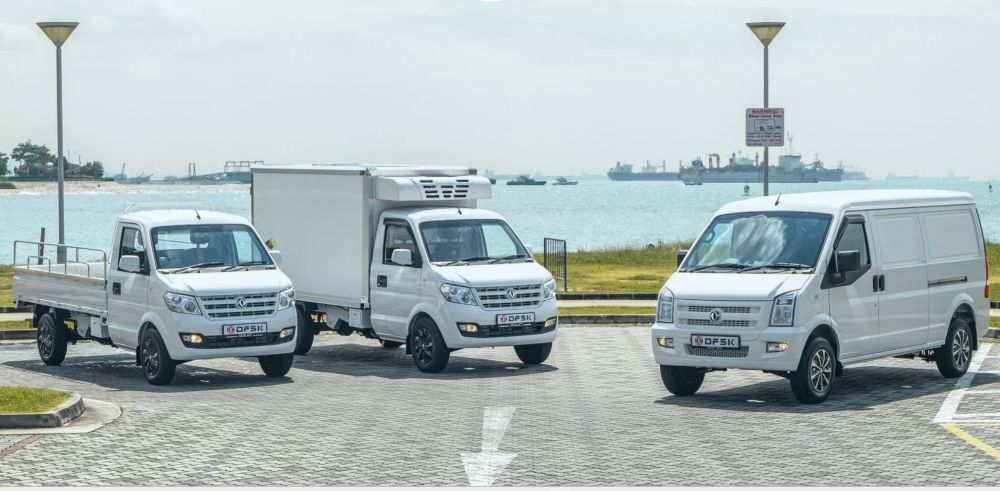
The right class depends on cargo weight, route profile, and the LTA registration category your load requires. Vehicle size and physical appearance don’t determine class; MLW does.
Most LGV and HGV body types now have electric equivalents, which means businesses can meet their required LTA class while reducing fuel and maintenance costs.
If you’re transitioning your commercial fleet from diesel to electric, follow these tips to ensure you choose the right vehicle for your business:
1. Assess Your Operational Needs
Consider these factors when assessing what your fleet will transport and where it needs to operate:
- Cargo Size and Weight: Calculate the maximum payload and dimensions needed for the largest items regularly transported, since this determines whether an LGV or HGV is required under LTA’s classification framework.
- Specialized Cargo: Identify whether temperature-controlled transport is needed, since temperature-sensitive and specialized cargo has distinct handling, environmental, and compliance requirements that often determine both vehicle class and body type. The DFSK EC31 Freezer Truck is designed specifically for cold-chain runs within the LGV class, while standard enclosed vans and lorries cover general and high-value dry cargo.
- Distance and Routes: Determine whether operations are primarily inner-city or inter-hub. Inner-city routes favor compact electric vans suited to high-stop-frequency urban delivery, while longer inter-hub runs need higher-range, higher-payload models like the Farizon H9E or Chenglong L2 EV.
2. Calculate the Total Cost of Ownership (TCO)
Vehicle price at the point of purchase is only one part of the cost picture. Registration fees, running costs, and any fit-out work add significantly to the total:
- Upfront Costs: Factor in vehicle price alongside mandatory registration fees, COE category and insurance, and compare options within the same LTA weight class before committing.
- Running Costs: Compare electricity versus diesel consumption and maintenance requirements across equivalent models. Electric commercial vehicles typically have lower running costs than diesel equivalents in the same class, since fewer powertrain components reduce servicing frequency and cost.
- Customization: Account for the cost of fit-out work such as shelving, racking, and branding decals, which add to the total investment beyond the base vehicle price and vary depending on operational requirements.
3. Evaluate Vehicle Types Within Your Class
Deciding between an electric van and a truck within the confirmed LTA class is the final step before settling on a specific model:
- Vans: Best suited to businesses needing enclosed, secure cargo space for delivery, courier, or trade services. Hong Seh’s electric van configurations span several models across the DFSK EC35, DFSK EC31, Farizon Supervan, and Farizon V7E.
- Trucks and Lorries: Suited to operations handling bulk goods, palletized freight, or heavier logistics requiring larger deck space and payload capacity. The SRM T3EV, Farizon H9E, Farizon H5E, and Chenglong L2 EV are among the electric trucks covering the LGV-to-HGV range.
Have a Compliant, Cost-Efficient Fleet with Hong Seh Motors
LTA’s weight-based classification, paired with a clear assessment of cargo needs, route profile, and total cost of ownership, is the foundation of a practical fleet decision. Ordering the wrong vehicle class means correcting it later, often at high cost.
Hong Seh Motors is an authorized distributor across the full LGV-to-HGV range of commercial electric vehicles, from compact cargo vans to heavy-duty lorries and flatbeds. You can source the right vehicle for your LTA class and cargo profile from a single distributor, supported by in-house servicing and EV-certified technicians post-sale.
To match the right LTA category, vehicle type, and electric model to your specific operation, contact Hong Seh Motors for a fleet consultation.
Comments are closed